Progressive Muscle Relaxation

Progressive muscle relaxation is a technique to help you learn what being relaxed actually feels like. Letting go of tension is a useful skill, but to do that, we first need to learn to notice when it’s there. This practice works by deliberately tensing each muscle group in turn, then releasing it, so you become more aware of the difference between tension and relaxation.

Like any skill, it becomes easier the more you practice it. The audio below will guide you through it, tensing and releasing one muscle group at a time, so you can simply follow along.

How to practice

Find a comfortable position, sitting or lying down, somewhere you won’t be disturbed.

Follow along with the audio, which will guide you through each muscle group in turn.

For each muscle group, tense it firmly, but not so hard that it hurts, and hold for a few seconds.

Then release the tension all at once, and notice the difference between how the muscle felt tensed and how it feels now, relaxed.

Pause for a moment before moving on to the next muscle group, letting your body settle.

Continue working through each muscle group as the audio guides you, staying with the feeling of relaxation as it spreads.

When you’ve finished, take a moment to notice how your body feels overall, then gently bring your focus back to the room around you.

Progressive Muscle Relaxation

Download audio

Box Breathing

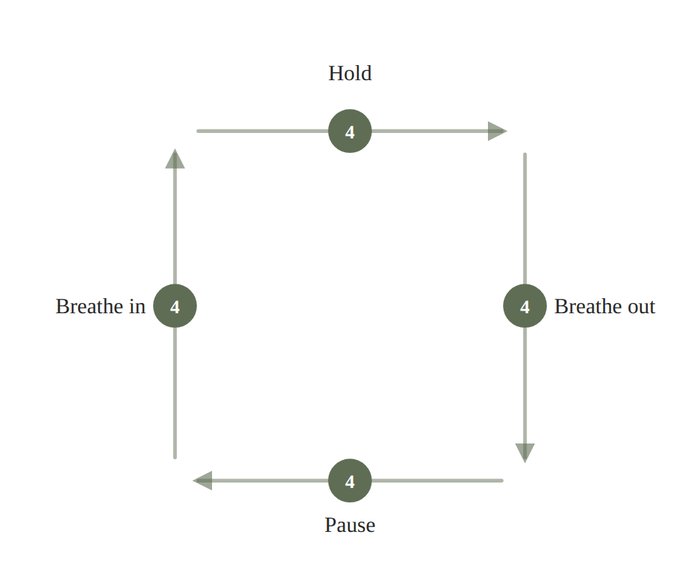
Box breathing, also called four-square breathing, is a simple technique for slowing your breathing down and calming your nervous system. It works by breathing in a steady, even rhythm: breathing in, holding, breathing out, and holding again, each for the same count. It’s used by everyone from athletes to emergency responders to help them stay calm and focused under pressure, and it’s just as useful for everyday stress.

Like any skill, it becomes easier the more you practice it. You can use it any time you need to settle yourself, whether that’s before something stressful, or simply as a regular practice to help you feel calmer overall.

How to practice

Find a comfortable position, sitting or lying down, wherever you are.

Breathe out fully, letting your lungs empty.

Breathe in slowly through your nose for a count of four.

Hold your breath gently for a count of four.

Breathe out slowly through your mouth for a count of four.

Pause for a count of four.

Repeat this cycle for a few minutes, keeping each count steady and even. When first starting, doing this for one minute is fine.

If a count of four feels too long, start with a shorter count, such as three, and build up as it becomes more comfortable.

When you’re ready, let your breathing settle back into its natural rhythm.

Five Senses Noticing

Five senses noticing is a grounding practice, a way to help you stay connected to what is happening around you right now. It’s a useful skill for reconnecting with life and refocusing your attention when your mind has drifted, or when you’re feeling overwhelmed. It can also have a calming effect. The aim is simply to be present with your experience.

Like any skill, it becomes easier the more you practice it. You don’t need anything special for this one, just a moment to pause, wherever you happen to be.

How to practice

Find a safe, convenient moment to pause, wherever you are. Plant your feet, and notice the connection to the ground.

Look. Name five things you can see.

Listen. Name four things you can hear.

Feel. Name three things you can touch.

Smell. Name two things you can smell.

Taste. Name one thing you can taste.

Take a few seconds to tune into yourself and your surroundings.

Take a breath, and resume what you were doing.

If 5 things feels like too much, try 1 thing per sense: 1 thing I can see, 1 thing I can hear, …

Five Senses Noticing

Download audio

Diaphragmatic breathing

Diaphragmatic breathing, also called deep breathing or belly breathing, is a way of breathing slowly and fully into the abdomen rather than the chest. When we’re stressed, our breathing often changes: it becomes shallower and faster, and this plays a part in keeping us feeling wound up, because it reduces the time the body has to rest and repair. Practising diaphragmatic breathing regularly gives the body a chance to settle, and it can also be a useful way to calm yourself in the moment when you’re feeling stressed.

What is the diaphragm?

The diaphragm is a large, dome-shaped muscle that sits underneath your lungs, separating your chest from your abdomen. When you breathe in, it contracts and flattens, drawing air deep into your lungs and making room by pushing your abdomen, and your lower ribs, gently outward. When you breathe out, it relaxes back into its dome shape. Breathing this way, using the diaphragm fully, is a more efficient and calming way to breathe than shallow breathing high in the chest.

Like any skill, it takes a little practice. The instructions below will talk you through it, and you can follow along with the audio whenever it’s helpful.

How to practice

Find a safe, quiet space where you won’t be disturbed.

Sit or lie down, and make yourself comfortable. If you’re sitting, place your feet flat on the floor with your legs uncrossed. If you’re lying down, let your feet flop outward.

Close your eyes, or let your gaze soften, and turn your attention inward.

Take a few normal breaths, not big breaths, just your usual volume, in through your nose and out through your mouth. Notice any tension in your shoulders, neck, stomach or chest, and allow it to relax. Let your breath slow, and take a few moments to settle.

Place one hand on your chest and the other on your lower abdomen.

Fully exhale, letting your lungs empty, then let your breath settle into its own natural rhythm. Without trying to change anything, simply notice which hand is moving: are you breathing mainly into your chest, with the upper hand moving, or into your abdomen, with the lower hand moving?

Now bring your focus to breathing using your diaphragm. It can help to imagine your lower abdomen like a balloon. As you exhale, the diaphragm relaxes and the abdomen deflates, so the lower hand moves inward. As you inhale, the diaphragm pulls out and downward, the abdomen inflates and your lower ribs widen slightly too, so the lower hand moves outward. Your chest and upper ribcage stay relaxed, so the upper hand stays still, or only moves a little.

When you’re ready: exhale, and feel the lower hand move inward. Inhale, and feel the lower hand move outward, your lower ribs widening a little as you do. Continue breathing this way, slowly and deeply, for around five minutes.

When you’re ready, open your eyes, look around, and shift your focus back outward.

Diaphragmatic Breathing

Download audio